Sustainable Packaging in the UAE: From Compliance to Competitive Advantage
The clock is ticking. Come January 1, 2026, the food and beverage industry across the UAE will face a fundamental transformation in how products are packaged, delivered, and perceived by consumers. What started as an environmental mandate has evolved into something far more strategic – a genuine opportunity for forward-thinking food business growth through innovation in sustainable food brands. For restaurant owners, cloud kitchen operators, and food entrepreneurs, understanding this shift isn’t just about avoiding penalties; it’s about repositioning your brand in a market increasingly defined by circular economy principles.
Understanding the 2026 Regulatory Landscape
The Ministry of Climate Change and Environment has issued Phase Two of Ministerial Decision No. 380 of 2022, which fundamentally reshapes what packaging materials are permissible in the UAE market. The expanded restrictions now target beverage cups and lids, cutlery, straws, stirrers, and plastic or foam food containers used by restaurants, hotels, catering companies, and retail outlets. Beyond Dubai’s phase three implementation, the UAE-wide ban creates a standardized framework that affects every player in the food industry, from cloud kitchen business operators managing delivery logistics to established restaurants rethinking their entire supply chain.
What makes this regulatory wave different is its structure. Rather than simply banning materials outright, the new framework actively encourages material innovation by exempting certified biodegradable materials such as bagasse, cornstarch, PLA, CPLA, and high-grade recyclable plastics. This creates a clear pathway for businesses willing to invest in compliant solutions.
Why This Matters for Your Food and Beverage Business
For anyone involved in restaurant consulting or food technology innovation, the 2026 deadline represents a compression of what might have taken a decade into just months. Industry observers suggest that regulatory certainty around approved materials has dramatically accelerated transition timelines. Consider a typical scenario: a mid-sized QSR chain operating across three emirates with 15 outlets currently manages packaging from multiple suppliers. Under the old uncertainty, transitioning to sustainable alternatives seemed risky – costs were unclear, material performance was unproven, and supply chain reliability remained questionable. Today, that same operator has clear exemptions for plant-based solutions and verified recycled materials, reducing decision paralysis significantly.
The economic stakes are substantial. The UAE’s Green Agenda 2030 and Net Zero 2050 commitments drive enforcement through the import, production, and circulation restrictions. Non-compliance doesn’t just mean fines; it means operational disruption, inability to source materials, and severe reputational damage in a market where sustainability increasingly influences consumer purchasing decisions.
The Material Innovation Opportunity
Smart food processing consultants and restaurant setup consultants now recognize that sustainable packaging isn’t merely a constraint – it’s a differentiator. The approved material categories create genuine competitive space. PLA biopolymers derived from plant sources, paper-based solutions, and certified recycled content options each carry different performance characteristics, cost implications, and environmental narratives.
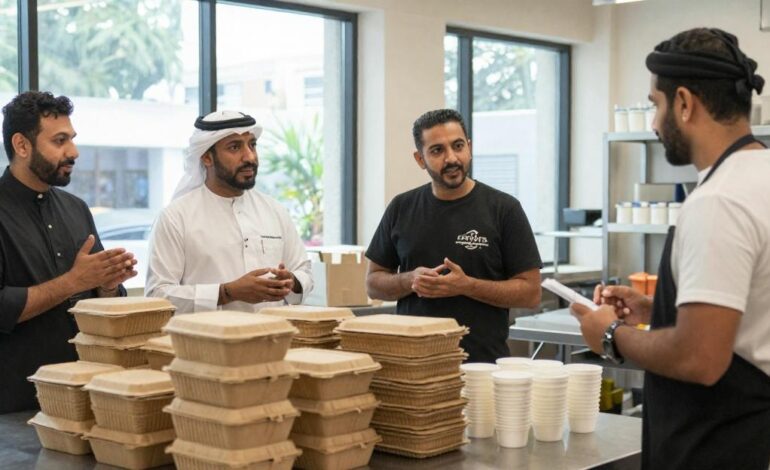
Paper packaging, for instance, has emerged as the most practical alternative for many food service applications. Paper food packaging in the UAE offers biodegradability, renewability, and improved food safety features that align with both regulatory requirements and consumer expectations. For cold chain applications like cloud kitchen deliveries, CPLA (certified compostable polylactic acid) cutlery and bagasse clamshells provide durability while meeting compostability standards.
Practical Action Steps for Food Business Experts
Moving from awareness to implementation requires structured action. Consider these foundational strategies:
- Conduct a comprehensive packaging audit across all product lines and delivery channels – identify every item currently manufactured from fossil-based plastics or non-compliant materials, then map transition timelines based on supplier capacity and cost variables
- Partner with certified food business consultants who understand both material science and UAE regulatory requirements – they can validate that your chosen alternatives meet EN13432 or ASTM D6400 compostability standards while optimizing for your specific food safety and operational needs
- Engage suppliers early to secure material declarations, certificates of conformity, and PFAS-free statements – documented compliance reduces audit risk and demonstrates due diligence to regulators and conscious consumers
The Circular Economy Imperative
Beyond compliance, the 2026 regulations embed circular economy thinking into food industry trends. Rather than viewing packaging as linear waste, the framework encourages systems where materials cycle back into productive use. For sustainable food brands, this creates genuine narrative power. A cafe consultant helping a specialty coffee roastery transition to compostable cups isn’t just meeting a regulation – they’re building a story around environmental stewardship that resonates with premium consumers willing to pay for alignment with their values.
Local production gains strategic importance in this shift. Historically, the region imported biopolymers and compostable materials at significant cost and lead-time risk. As demand accelerates toward 2026, local manufacturing capacity for bagasse containers, CPLA cutlery, and paper-based solutions is expanding. This creates opportunities for food factory design consultants to help entrepreneurs establish local production facilities, reducing supply chain vulnerability while supporting the UAE’s bioeconomy ambitions.
Real-World Implementation: A Cloud Kitchen Case Study
Consider a Delhi-based cloud kitchen operator who recently expanded to the UAE. Her operation managed delivery across five emirates using plastic containers and polystyrene bases – cost-effective but suddenly non-compliant. Rather than panic, she engaged a food consultant services firm that specializes in cloud kitchen business optimization. Together, they transitioned to certified bagasse containers for hot foods and PLA cold cups for beverages, reducing packaging weight by 18% while cutting waste disposal costs by 22%. The transition cost 12% more per unit initially, but premium pricing on sustainability-positioned delivery items and operational savings created payback within eight months. By January 2026, she’ll be perfectly positioned while competitors scramble.
Measuring Success: Beyond Compliance
Sustainable packaging transition success extends beyond regulatory checkbox completion. food and beverages consultants increasingly measure impact across multiple dimensions: material waste reduction, supply chain resilience, brand perception shifts, and margin optimization. These metrics matter because they transform a compliance burden into a business case.
The data reinforces this opportunity. Research indicates that consumers in the UAE show 34% higher purchase intent for brands explicitly communicating sustainability commitments through packaging changes. For food technology innovators, this creates competitive leverage – first-movers in sustainable packaging gain not just regulatory advantage but market positioning as environmental leaders.
Supply Chain and Operational Considerations
The transition involves more than material swaps. Food safety remains paramount. Paper-based packaging for wet foods, hot applications, and high-moisture products requires technical validation to ensure barrier properties meet food safety standards. PLA performs well in cold applications but degrades under high temperature exposure. CPLA offers thermal resistance but at higher cost. Your food business growth strategy must account for these nuances.
Supplier relationships become critical. Partnering with experienced suppliers ensures supply stability, certification support, and material selection tailored to your specific product formats. For restaurant consulting and qsr consultants, this means vendor consolidation around partners who can supply multiple approved materials with documented compliance and consistent quality.
Training and Consumer Communication
Internal readiness often gets overlooked. Staff handling new packaging materials – from prep line workers to delivery personnel – require training on proper handling, storage, and disposal. Simultaneously, customer communication shapes perception. The shift from plastic to compostable materials doesn’t happen invisibly. Smart food business growth incorporates this transition into brand narrative. Simple labeling changes, in-store signage, and digital communication explaining your sustainability commitment transform potential customer friction into brand differentiation.
Frequently Asked Questions (FAQs)
How much additional cost should I expect from transitioning to compliant packaging? Material costs typically increase 8-15% depending on the specific material and volume. However, this calculation must account for secondary savings – reduced waste disposal fees, lighter packaging reducing delivery costs, and premium pricing opportunities from sustainability positioning. Many operators find total cost of ownership improves within 12-18 months as volumes scale with suppliers.
Will compliant materials affect food safety or shelf life? No, if you select appropriate materials for your specific applications. Paper works excellently for dry goods and room-temperature items. CPLA maintains thermal integrity for hot foods. PLA excels for cold products. The key is matching material properties to application requirements – something food processing plant consultancy services help validate through proper testing.
What if my suppliers can’t provide compliant materials by January 2026? This is a legitimate concern that requires immediate action. Engage food processing services firms who maintain relationships with UAE-compliant suppliers. Many have pre-qualified material sources and can facilitate rapid transitions. Waiting until Q4 2025 creates genuine supply risk.
Does the regulation require local manufacturing or can I import compliant materials? Import is permitted provided materials meet regulatory standards and include proper documentation – certificates of conformity, material declarations, and PFAS-free statements. However, local production is increasingly cost-competitive and reduces lead-time risk. Food factory design consultants can evaluate whether local production makes economic sense for your volume.
How do I communicate these changes to customers without appearing forced by regulation? Reframe this as environmental leadership, not compliance. Restaurants that position sustainable packaging as brand choice rather than regulatory requirement generate positive consumer response. Use delivery apps, invoices, and signage to tell your sustainability story authentically.
Your Path Forward
The 2026 UAE sustainable packaging mandate arrives not as punishment but as opportunity. For food business growth, the operators who thrive are those treating this transition as strategic repositioning rather than grudging compliance. The material landscape now supports genuine innovation – from locally-produced bagasse solutions to advanced compostable polymers designed specifically for foodservice applications. Your food industry consultant and food processing consultants should be helping you view this deadline as a catalyst for competitive advantage.
The clock is running, but the runway is clear. Every month you delay increases implementation pressure and supply chain risk. Every month you move forward builds organizational capability and market positioning. This isn’t about checking a regulatory box – it’s about building a more resilient, differentiated food and beverage business prepared for the circular economy already taking shape across the UAE.
Ready to transition confidently? Connect with Tech4Serve today – our experts in food consulting, cloud kitchen optimization, and sustainable supply chain solutions help operators across the region navigate packaging transformation strategically. Let’s turn January 2026 from a deadline into your next competitive advantage.