Sustainable Packaging in the UAE: Your Business Blueprint for 2026 and Beyond
The clock is ticking. As of January 1, 2026, the UAE has implemented sweeping restrictions on single-use plastics that will fundamentally transform how food businesses operate across the Emirates. For restaurant owners, cloud kitchen operators, and food brands, this isn’t just regulatory compliance – it’s a strategic opportunity to align with global food industry trends, strengthen brand reputation, and tap into the growing market of eco-conscious consumers who demand sustainable food brands.
Understanding the 2026 Plastic Ban: What’s Actually Changing
The UAE’s expanded single-use plastics regulations, issued under the second phase of Ministerial Decision No. 380 of 2022, mark a decisive shift in how the country approaches waste management and environmental stewardship. Unlike the first phase, which focused on limiting problematic plastic products, the new framework places greater emphasis on material innovation and circular economy principles.
Effective immediately, a wide range of foodservice items made from conventional fossil-based plastics are now prohibited across the Emirates. This includes beverage cups and lids, cutlery, straws, stirrers, plastic and foam food containers used by restaurants, hotels, catering companies, and retail outlets. However – and this is crucial – these products remain permitted if manufactured using approved materials such as PLA biopolymers, paper, wood, or plastics with verified recycled content. Shopping bags with a thickness of less than 50 micrometers are also banned nationwide unless made from recycled materials or certified plant-based, biodegradable alternatives.
The policy represents more than environmental concern. It reflects the UAE’s broader commitment to the Green Agenda 2030 and Net Zero 2050 targets, positioning sustainable food brands and circular economy practices as central to the nation’s economic future.
Why This Matters for Your Food Business
If you operate a restaurant, manage a cloud kitchen business, or lead a food and beverage industry venture in the UAE, this regulation directly impacts your packaging strategy, supplier relationships, and customer experience. The transition isn’t optional – it’s structural and permanent.
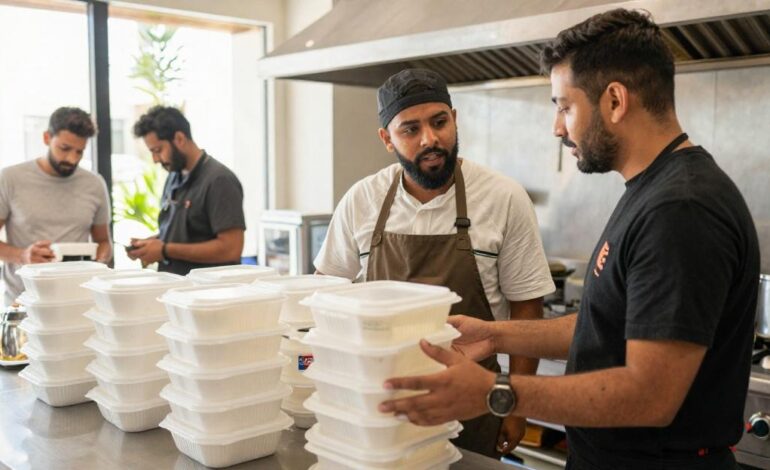
Consider the real-world impact: a QSR chain operating 15 outlets across Dubai was using approximately 50,000 plastic containers monthly. Under the new rules, they faced a critical choice: migrate to compliant materials or face import and manufacturing restrictions. They partnered with food business consultants to audit their supply chain, test alternative packaging, and implement a phased transition. Within six months, they reduced their carbon footprint by 35% while simultaneously attracting environmentally conscious customers willing to pay premium prices for sustainability.
This scenario repeats across the food and beverage industry. Recent data shows that 85% of UAE food businesses expect the 2026 deadline to accelerate their investment in sustainable packaging solutions, with supply chain managers reporting that regulatory clarity has compressed transition timelines from a decade into just two to three years.
Approved Materials: Your Sustainable Packaging Options
Understanding your material choices is foundational to making smart packaging decisions. The approved alternatives fall into several categories, each with distinct advantages for different food products and applications.
Plant-Based Biopolymers (PLA) are emerging as the gold standard for beverage cups, food containers, and cold-food applications. PLA is derived from renewable resources like corn starch, biodegrades in industrial composting facilities, and offers similar performance characteristics to conventional plastic. Restaurants using PLA report that customers notice minimal difference in product quality or presentation.
Paper and Cardboard solutions provide excellent versatility for dry goods, baked items, and takeaway containers. Paper packaging suppliers are expanding capacity rapidly across the region, and local warehousing is stabilizing supply chains. food processing consultants now frequently recommend paper-based solutions for their proven track record and consumer familiarity.
Recycled Plastics (RPET and CPET) maintain the structural integrity of virgin materials while closing the loop on existing waste streams. These materials work particularly well for rigid food containers where durability matters. Bagasse – a fibrous byproduct of sugarcane processing – offers biodegradable strength for hot-food applications and is increasingly produced regionally.
Wood-Based Products like wooden cutlery and stirrers provide natural, premium alternatives that enhance brand perception. Cloud kitchen business operators have found that wood cutlery appeals to consumers seeking authentic, sustainable experiences.
The Strategic Business Case for Sustainable Packaging
Moving beyond compliance, sustainable packaging delivers measurable business benefits. food technology innovation in the packaging space is accelerating, with suppliers developing materials that outperform legacy plastics on durability, shelf-appeal, and cost-efficiency.
A recent analysis of UAE food business transitions shows that companies implementing sustainable packaging early report 18-24% improvement in brand perception scores among target demographics, particularly millennial and Gen Z consumers. Food business growth metrics also reveal that restaurants marketing their sustainable packaging choices experience higher social media engagement and customer loyalty.
From a food safety perspective, approved materials like PLA and CPET meet all UAE food contact standards. Food safety regulations continue to tighten, but approved sustainable materials are rigorously tested and certified. Food consultants advise that businesses should prioritize suppliers offering full food safety documentation and traceability.
Cost considerations warrant honest discussion. Initial transition expenses include material testing, equipment retooling, supplier qualification, and staff training. However, progressive restaurant consulting firms report that these costs are offset within 12-18 months through waste reduction, improved customer retention, and premium pricing opportunities. The food industry trends clearly favor brands perceived as environmentally responsible.
Practical Steps to Execute Your Transition
Here’s what food business experts recommend as a structured approach to compliance and competitive advantage:
- Conduct a comprehensive packaging audit within the next 30-60 days. Map every single-use plastic item currently in your operation – from delivery packaging to end-user containers to internal processing materials. Partner with food business consultants or a food consultant services firm to identify high-impact changes and low-hanging fruit for quick wins.
- Test materials with real customers before full-scale rollout. Run pilot programs using alternative packaging on select menu items or at specific locations. Gather feedback on functionality, appearance, and customer perception. This data becomes invaluable when scaling across multiple outlets.
- Negotiate long-term supply agreements with certified vendors now, before demand peaks and supply tightens. Food factory consultants and turnkey food factory consultants can facilitate supplier introductions and contract negotiations. Building relationships with reliable suppliers of PLA, paper, and other approved materials ensures price stability and delivery security through 2026 and beyond.
- Invest in staff training immediately. Your operations teams need to understand the functional differences between materials. A plastic cutlery works differently than wood; paper containers require different handling than foam. Training prevents operational missteps and customer service issues during the transition.
- Communicate transparently with customers. Frame sustainability as a positive brand differentiator rather than a forced compliance measure. Share your sustainability story across digital channels, point-of-sale materials, and packaging itself. Food business growth accelerates when customers understand and support the transition.
Local Production and Supply Chain Resilience
A critical development reshaping the food industry trends is the emergence of domestic PLA production and regional material manufacturing. The UAE market is now better positioned to absorb demand surges than it was even two years ago, thanks to new production capacity and strategic stockpiling across the Gulf region.
This creates opportunity. Local manufacturers are not only producing materials but adapting equipment, retraining workforces, and redesigning production processes to ensure proper end-of-life performance. For food and beverage consultants advising businesses, this means recommending locally-sourced sustainable packaging when possible – reducing logistics costs, supporting circular economy objectives, and strengthening supply chain resilience.
cafe consultant services and qsr consultants working across the region report that businesses prioritizing local suppliers experience faster delivery times, more flexible minimum order quantities, and stronger partnerships. These advantages compound when managing multiple outlets across emirates.
Sustainability as Competitive Strategy
The 2026 ban isn’t an isolated policy. It reflects a broader evolution in how the UAE views sustainable food brands and circular economy models as cornerstones of future economic competitiveness. Businesses that embrace this transition early position themselves as innovation leaders rather than reluctant compliers.
Food business experts working with leading restaurant chains report that sustainability messaging drives measurable customer acquisition. A Dubai-based cloud kitchen business that repositioned around sustainable packaging saw online order volume increase 22% within six months of launch, with new customer acquisition rates outpacing pre-transition baselines significantly.
This connects directly to food business growth objectives. Sustainable food brands command premium pricing, attract partnerships with conscious retailers and corporate catering clients, and generate positive PR momentum. In an increasingly crowded market, differentiation matters – and sustainability is a proven differentiator.
Frequently Asked Questions (FAQs)
What happens if my business doesn’t comply with the 2026 plastic ban?
Non-compliance carries significant consequences. The Ministry of Climate Change and Environment has outlined clear enforcement measures, including import restrictions, manufacturing suspensions, and trading prohibitions on non-compliant products. Beyond regulatory penalties, non-compliance damages brand reputation in a market where sustainability increasingly influences consumer choice. Food business experts strongly recommend viewing 2026 as a hard deadline rather than a guideline.
Will sustainable packaging cost significantly more than conventional plastic?
Initial material costs for some sustainable alternatives – particularly PLA and bagasse – are comparable to or only slightly higher than conventional plastic. However, total cost of ownership depends heavily on volume, supplier relationships, and supply chain efficiency. Food consultants working with high-volume operators report that economies of scale kick in within 12-18 months, with total packaging costs stabilizing or declining compared to pre-transition baselines. Smaller operators may experience temporary cost increases, but these typically improve as market volumes increase and competition among suppliers intensifies.
Are PLA and other approved materials actually composted in UAE facilities?
This is an important consideration. PLA requires industrial composting facilities – home composting doesn’t work effectively. While the UAE’s industrial composting infrastructure is expanding, not all approved materials are currently composted domestically. However, this infrastructure gap is closing rapidly as demand increases. food processing consultancy services now frequently include waste management strategy as part of sustainability planning, helping businesses understand end-of-life pathways for their chosen materials.
Can we still import finished food products in plastic packaging?
The ban applies to import, manufacturing, and trade of prohibited single-use plastic items. Finished food products imported in compliant packaging are permitted. However, businesses importing bulk ingredients in non-compliant packaging need to repackage before retail sale. This creates opportunity for local food processing services firms offering repackaging and fulfillment capabilities.
Your Next Steps: Building a Future-Ready Food Business
The 2026 plastic ban represents a turning point for the UAE food and beverage industry. Businesses that view this as a compliance checkbox will survive. Businesses that view it as a strategic opportunity to strengthen brand positioning, improve operational efficiency, and capture market share will thrive.
Your transition should begin immediately. Start with a comprehensive packaging audit. Test materials with real customers. Build relationships with certified sustainable packaging suppliers. Train your operations teams. Communicate your sustainability story authentically to customers. Partner with experienced advisors – whether food industry consultants, food factory design consultants, or restaurant setup consultants – who understand both the regulatory landscape and the commercial realities of operating in the competitive UAE food market.
The window between now and January 2026 is narrowing. But it’s sufficient time to execute a thoughtful, strategic transition if you act with urgency and intentionality. Your brand reputation, your customer relationships, and your competitive positioning depend on it.
Ready to transform your packaging strategy and future-proof your food business? Connect with Tech4Serve today. Our team of food business experts, restaurant consultants, and supply chain specialists can guide your transition to sustainable packaging with precision, efficiency, and proven results. Let’s build your path to 2026 compliance and beyond.