Product Development for the Indian Palate: The Strategic Edge in UAE’s Booming Food Market
The UAE food and beverage industry is witnessing explosive growth, with the foodservice market alone valued at USD 27.28 billion in 2026 and projected to reach USD 61.21 billion by 2031. Yet behind this expansion sits a critical insight: successful product development isn’t about chasing global trends blindly – it’s about understanding the nuanced preferences of the Indian palate that has become central to the region’s food culture. With over 3.5 million Indians calling the UAE home, and Indian food products dominating supermarket aisles from Dubai to Abu Dhabi, the opportunity for brands that authentically develop products rooted in Indian tastes has never been more compelling.
Why the Indian Palate Matters More Than Ever in the UAE
Walk into any major retail chain across Dubai and you’ll notice something striking: Indian foods, spices, and packaged goods occupy entire sections. But this isn’t merely because of the Indian diaspora. Emiratis, Arabs, Africans, and Europeans actively choose Indian products because they’re familiar, competitively priced, and consistently deliver quality. What makes this opportunity even richer is that the UAE’s diverse consumer base generates demand for authentic ethnic dining, creating a ripple effect across the entire food industry trends landscape.
For food and beverage industry leaders, this means product development strategies must start with a fundamental question: How do we honor the Indian palate while meeting the UAE’s evolving expectations for quality, convenience, and health consciousness? The answer isn’t straightforward, but the data is encouraging. India’s exports to the UAE in the food and beverages sector have grown from USD 1.6 billion in 2019 to USD 2.9 billion in 2024, representing a 12.4% five-year compound annual growth rate. This trajectory reflects not just volume but a fundamental shift toward value-added, thoughtfully developed products.
Understanding the Core Elements of Successful Product Development
Product development for the Indian palate in the UAE context requires balancing three interconnected elements: authenticity, innovation, and regulatory compliance. Many emerging brands stumble by prioritizing only one dimension. Pankaj Sajnani, Commercial Head for GCC Grocery Food and Frozen at Choithrams, articulates this perfectly: India remains a strong sourcing destination for Choithrams, with significant untapped opportunities in staples, authentic and region-specific specialties, and innovative, health-oriented products. For Indian suppliers, consistent quality and reliability, supported by a robust supply chain, will be critical to unlocking sustainable growth in the UAE market.
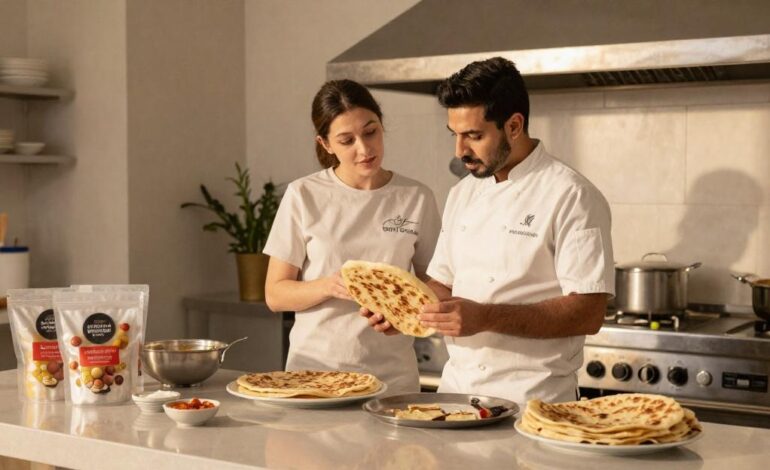
This insight underscores a reality that restaurant consulting and food business growth professionals in the UAE consistently emphasize: products developed for the Indian palate don’t succeed merely by replicating what works in India. Instead, they must be thoughtfully adapted. A frozen paratha brand, for instance, can’t simply import the same product; it must consider the storage preferences of UAE households, the packaging sustainability concerns of environmentally aware buyers, and the convenience expectations of time-constrained professionals.
The Health and Wellness Shift
Health consciousness is reshaping product development priorities across the food technology landscape. Organic pulses, millets, cold-pressed oils, natural sweeteners, and Ayurvedic consumables are increasingly visible on supermarket shelves and online grocery apps. The packaged food market in the UAE is growing at 6.5% CAGR, driven significantly by consumers seeking healthier alternatives. For brands rooted in the Indian palate, this presents a golden opportunity: Indian cuisine already contains centuries-old wisdom around wellness foods, from turmeric to cumin to fenugreek.
What’s changed is consumer expectation. Today’s UAE buyer wants transparency – they want to know where ingredients come from, how they’re processed, and what health benefits they deliver. Food Business Experts working with Indian brands consistently recommend developing products that marry traditional Indian ingredient knowledge with modern clean-label standards, certification processes, and storytelling around traceability.
Cloud Kitchen Business and Product Testing
One of the most practical approaches to product development has emerged through the cloud kitchen business model. Rather than launching directly into retail with massive capital investment, many Indian food entrepreneurs are using cloud kitchens as innovation laboratories. They test flavor profiles, portion sizes, and packaging concepts with real consumers, gather feedback through delivery apps, and refine their offerings before scaling to retail distribution.
This approach works because it allows food technology integration – tracking which dishes resonate, which ingredients generate repeat orders, and which price points optimize conversion. Restaurant consulting professionals in Dubai increasingly recommend this pathway to emerging brands, particularly those focused on frozen ethnic foods and ready-meal segments.
Building Sustainable Food Brands Anchored in Indian Authenticity
Sustainability is no longer a premium positioning strategy in the UAE; it’s becoming table stakes. Sustainable food brands that incorporate Indian ingredients and methodologies while addressing environmental concerns capture both the affluent health-conscious segment and younger consumers concerned about planetary impact. For product development teams, this means rethinking everything from sourcing to packaging.
Consider spices – traditionally packaged in single-use plastics. Innovative brands are now sourcing Indian spices directly from cooperative farms, emphasizing Fair Trade practices, and packaging them in compostable or recyclable materials. This approach honors both the Indian palate (authentic spice blends and sourcing) and UAE consumer values (sustainability and ethical consumption).
Food safety stands as the non-negotiable foundation. Indian products entering the UAE market must comply with stringent local regulations, and this compliance actually becomes a competitive advantage when communicated effectively. A product development consultant or food business consultants working with Indian exporters will emphasize that transparent documentation of food safety practices, certifications from recognized bodies, and third-party testing build trust with both retail buyers and end consumers.
Practical Strategies for Product Development Success
food factory design consultants and turnkey food factory consultant professionals working across the India-UAE corridor consistently point to three foundational strategies:
- Conduct structured consumer research within the UAE market specifically, rather than assuming Indian preferences translate directly. This means taste testing with diverse demographic groups, not just the Indian expatriate community, and understanding how Emiratis, Arabs, and other resident populations want to experience Indian flavors.
- Invest in food processing consultancy services that specialize in adapting Indian recipes and production methods for UAE retail standards. This includes guidance on portion sizing, shelf-life optimization, and packaging innovation that maintains product integrity while reducing waste.
- Develop a phased market entry strategy using food consultancy service providers who understand both the India-UAE CEPA trade framework and local distribution networks. This might involve launching through specialty retailers first, building brand credibility, and then expanding to hypermarkets and e-commerce channels.
The Role of Technology and Innovation
Food technology is accelerating product development cycles dramatically. The UAE food technology market generated USD 4.75 billion in revenue in 2023 and is expected to reach USD 8.9 billion by 2030. For Indian brands, this means leveraging data analytics to understand consumer preferences, using automation to maintain consistency across batches, and adopting traceability systems that communicate authenticity to buyers.
qsr consultants working with Indian quick-service restaurant chains emphasize that product development increasingly involves technology-enabled customer feedback loops. A biryani concept, for example, can use ordering data to identify which spice levels, rice varieties, and protein options generate the highest repeat purchase rates. This intelligence then informs whether to develop new regional variants, adjust existing recipes, or expand portion offerings.
Navigating Distribution and Retail Partnerships
Developing a product is only half the challenge; the other half is getting it onto shelves and into customer hands. Many Indian exporters discover that while they can produce excellent products, they lack connections with major retail chains or the marketing sophistication to compete for premium shelf space. food processing plant consultancy Services can guide brands through retail buyer conversations, helping articulate the market data, consumer demand signals, and supply chain reliability that major retailers like Choithrams, Carrefour, and Noon seek.
The India-UAE CEPA trade agreement has simplified tariff structures and documentation, making logistics more predictable. However, the competitive landscape remains intense. Brands that differentiate through authentic storytelling – connecting the product back to its Indian origins, the artisans or farmers involved, and the health or cultural significance – tend to secure stronger retail positions.
Building Brand Narrative Around Product Development
Successful Indian palate-focused products in the UAE increasingly tell stories. A spice brand might highlight the cooperative farms in Kerala it sources from. A frozen food company might explain how recipes were adapted from a grandmother’s kitchen in Mumbai. A bakery consultants working with Indian bakeries in Dubai notes that consumers increasingly want to know: Where does this come from? Who made it? Why should I trust it?
This narrative dimension becomes especially powerful when the product itself represents genuine innovation. For instance, combining traditional Indian ingredients like millet with modern formats like protein bars or plant-based snacks creates a natural story: ancient wisdom meets contemporary health consciousness.
Frequently Asked Questions (FAQs)
How do we determine if a product concept developed for India will work in the UAE market?
Market validation requires moving beyond assumptions. Conduct taste testing with a diverse UAE consumer panel, not just Indian expatriates. Use food consultancy service providers to analyze competitor offerings and identify white spaces. Test through cloud kitchens or pop-up retail before committing to large-scale production. Pay particular attention to how different demographic groups – Emiratis, Arabs, Western expats, and other Asian communities – respond to the product. Their feedback, combined with data on existing sales patterns for similar products in UAE retail, provides the most reliable indicator of potential success.
What regulatory hurdles should we anticipate when launching Indian food products in the UAE?
The UAE has rigorous food safety standards administered by local authorities, and all products require registration before retail sale. This includes nutritional labeling in Arabic and English, allergen declarations, and traceability documentation. Work with food processing consultants familiar with UAE compliance requirements – they can expedite approvals and help you understand labeling requirements specific to your product category. The good news is that compliance, while administratively intensive, isn’t prohibitively expensive and actually strengthens your market credibility once achieved.
Should we prioritize retail distribution or direct-to-consumer channels for an Indian palate-focused brand?
The answer depends on your product type and capital resources. Frozen ethnic foods and packaged staples typically succeed through retail partnerships because convenience and accessibility matter. Premium or artisanal products may perform better through e-commerce and specialty channels initially, building brand credibility before approaching major chains. Many successful brands employ a hybrid approach: start with online sales to build customer testimonials and sales data, use that proof-of-concept to negotiate retail shelf space, and eventually expand across both channels. Food Business Experts can help you design a phased entry strategy tailored to your specific category.
How important is sustainability messaging for Indian food products in the UAE?
Increasingly critical. UAE consumers, particularly younger demographics and affluent segments, actively prefer brands demonstrating environmental responsibility. For Indian brands, this translates to transparent sourcing narratives, eco-friendly packaging, and Fair Trade certifications. The beauty is that many Indian agricultural and artisanal practices already align with sustainability values – you’re often communicating authenticity rather than adopting new practices. Position sustainable practices as integral to your brand identity and product story, and you’ll resonate with premium-positioned consumers seeking both cultural authenticity and environmental consciousness.
Conclusion
Product development rooted in the Indian palate represents one of the UAE’s most compelling food business growth opportunities. The convergence of a massive Indian expatriate community, growing local and regional demand for Indian cuisine, favorable trade frameworks like the India-UAE CEPA, and increasing consumer interest in health, sustainability, and authentic global foods creates a perfect moment for thoughtfully developed products.
Success requires moving beyond nostalgia or direct replication of Indian market products. Instead, embrace a consultative approach: understand UAE consumer preferences deeply, invest in quality and food safety compliance, tell authentic stories about your products and origins, and use technology to maintain consistency and gather feedback. Whether you’re a frozen food innovator, a spice exporter, or a ready-meal developer, the foundation remains identical: honor the Indian palate while delivering products that meet UAE market expectations for quality, convenience, and values alignment.
Ready to transform your product concept into a market-winning reality? Partner with Tech4Serve – we combine deep food industry expertise with technology-enabled insights to guide Indian brands through every stage of product development, regulatory compliance, and market launch in the UAE. Let’s build something exceptional together.