Order Accuracy: The Hidden Profit Driver Behind UAE’s Food Delivery Boom
In the chaos of a Friday evening service, a single wrong order costs more than the food itself – it erodes customer trust, damages your brand reputation, and forces your operations team into costly recovery mode. As the UAE online food delivery market races toward $3.9 billion by 2030, growing at a compound annual rate of 7% to 10%, order accuracy has become the invisible backbone separating thriving restaurants from those struggling to maintain margins in an increasingly competitive ecosystem.
Why Order Accuracy Matters More Than Ever in the UAE Market
Mobile ordering now dominates transactions across the UAE, with mobile devices accounting for approximately 70% of delivery transactions and forecasts predicting this will exceed 80% by end of 2025. This explosive shift toward app-based ordering has fundamentally changed how restaurants operate. When your restaurant was taking orders primarily through phone calls and walk-ins, a mistake was often caught before it left the kitchen. Today, with three-quarters of all delivery orders channeled through aggregator apps like Talabat, HungerStation, and Deliveroo, the margin for error has shrunk dramatically. Restaurants are now processing order volumes at unprecedented scale – Talabat alone reported more than 47 million burger orders across the UAE in 2025 – making order accuracy not just a service metric but a critical operational lever.
The food and beverage industry in the UAE faces a unique challenge: balancing rapid growth with operational precision. According to Alexander Ponomarev, Chief Executive of Syrve MENA, a leading restaurant software provider, Mobile-based delivery will remain central to foodservice strategy as operators look to grow order volumes at more than 10% year-on-year while maintaining margins in a highly competitive ecosystem. This quote encapsulates the tension every operator faces. You cannot simply scale your order volume without simultaneously scaling your accuracy protocols.
The Financial Impact of Order Errors
Consider a hypothetical cloud kitchen business operating across Dubai with three virtual brands, each receiving 400-500 delivery orders per shift. If your order accuracy rate sits at 95%, you are fulfilling approximately 20-25 incorrect orders per shift. Over a week, that is 140-175 unhappy customers, refund requests, and damaged ratings on delivery platforms. Each incorrect order represents lost margin, customer service overhead, and platform reputation damage that compounds over time.
Research from leading food technology and restaurant consulting experts shows that high-performing restaurant operations teams maintain accuracy rates above 98.5%. The difference between 95% and 98.5% may sound marginal, but across high-volume delivery operations, it translates to tangible bottom-line impact through reduced chargebacks, improved platform ratings, and increased repeat order rates.
Root Causes of Order Errors in High-Volume Delivery Operations
Order inaccuracy rarely stems from a single cause. In UAE restaurants and cloud kitchens, the most common culprits include:
- Manual order entry and transcription errors when staff are manually inputting app orders into POS systems instead of using integrated platforms
- Kitchen communication breakdowns, particularly during peak hours when ticket flow exceeds staff bandwidth
- Special instruction misinterpretation, especially for customized orders with multiple modifications
- Inventory miscommunication, where orders are confirmed but ingredients are unavailable, forcing last-minute substitutions
- Packing and labeling errors, where the right food is prepared but placed in the wrong delivery bag
food business consultants specializing in food and beverage operations have identified that restaurants relying on manual workflows – paper tickets, verbal handoffs, and visual scanning – experience error rates 2-3 times higher than those using integrated food technology solutions.
How Smart POS Integration Reduces Order Errors
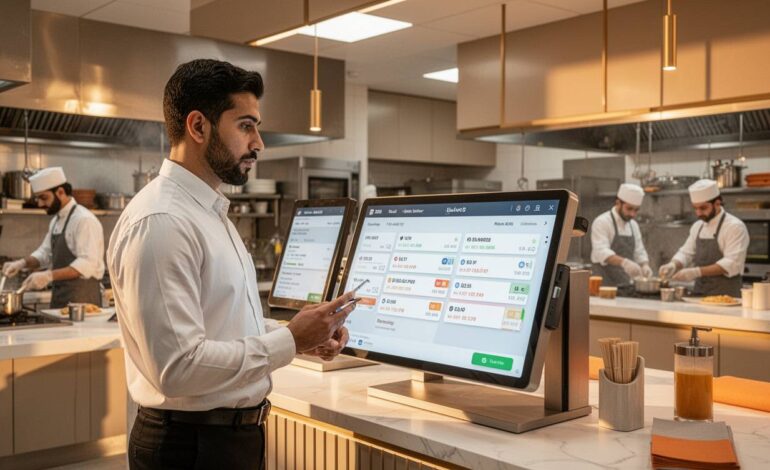
Leading operators across the UAE have already begun transforming order accuracy through integrated point-of-sale platforms. Rather than staff manually entering delivery app orders into kitchen systems, integrated POS platforms automatically push orders directly from aggregator apps to kitchen display systems in real-time. This eliminates the transcription step entirely – the single biggest source of preventable errors.
Syrve’s data shows that restaurants increasing adoption of smart POS platforms are seeing order accuracy improvements of 3-5 percentage points within 30-60 days of implementation. For a 1000-order-per-day operation, this translates to 30-50 fewer errors monthly – a meaningful reduction that directly affects customer satisfaction scores and delivery platform ratings.
Specialized food consultancy services that work with QSR chains and cloud kitchens recommend implementing the following technical safeguards:
- Real-time order confirmation screens that show customers the exact items, quantities, and modifications before payment is processed
- Kitchen display systems that break down each order by station and flag items requiring special attention or custom preparation
- Barcode-based order verification at packing, where staff scan items before they enter delivery bags to confirm accuracy
Training and Standard Operating Procedures That Stick
Technology alone cannot solve order accuracy challenges. Your team execution matters equally. The most effective food safety and operational protocols combine automated checks with human accountability.
restaurant setup consultants working with Dubai-based establishments have helped implement training frameworks that reduce errors through:
- Daily accuracy huddles where your operations team reviews the previous day’s errors and discuss root cause solutions as a team
- Clear role definitions during peak hours – designating a single staff member as the accuracy checker during service rush
- Visual training on how to read and interpret special instructions, with real examples from your most-ordered items
A practical example: a successful Arabic food delivery concept in Dubai implements a 60-second pre-dispatch review where each completed order is visually inspected against the kitchen ticket before it is handed to the delivery partner. This simple friction point catches approximately 8-12 errors per day, preventing negative customer experiences and platform complaints.
Leveraging Data to Improve Over Time
Modern food technology platforms generate detailed order-level data that reveals accuracy trends. Rather than treating order errors as isolated incidents, food business growth depends on analyzing error patterns systematically. Are certain menu items ordered incorrectly more frequently? Does accuracy drop during specific times or days? Are particular staff members associated with higher error rates?
Leading food industry trends show that restaurants using data-driven approaches to error reduction are outpacing competitors by capturing more market share through superior ratings. Delivery platforms like Talabat and Deliveroo explicitly factor order accuracy into search rankings and recommendation algorithms. Higher accuracy means better visibility, more orders, and faster growth.
food processing consultants recommend implementing weekly accuracy reviews where your management team examines order data from your POS system or delivery platform dashboard. This 30-minute investment can identify systemic issues before they become reputation threats.
Seasonal Peaks and Accuracy Under Pressure
The UAE food delivery market exhibits pronounced seasonal volatility. Ramadan traditionally delivers the year’s largest operational surge, with 41% of UAE residents increasing food spending, and summer months see another surge as extreme heat shifts consumption online. These periods test your operational resilience. Many restaurants that perform well year-round struggle during Ramadan when order volumes spike 30-40% above baseline.
Preparing for these predictable surges requires proactive staffing and process adjustments. Food Business Experts recommend that restaurants plan for peak periods three to four weeks in advance by:
- Recruiting and training temporary kitchen staff during the month before Ramadan
- Simplifying menu offerings during peak demand periods to reduce customization variables
- Running mock service simulations with your full team to identify bottlenecks before they appear during actual service
Frequently Asked Questions (FAQs)
What is the typical order accuracy rate in UAE delivery restaurants, and how does it compare globally?
Leading UAE restaurant operators maintain accuracy rates between 97-99%, while industry global benchmarks typically range from 93-96%. The variance depends significantly on whether restaurants use integrated technology or manual processes. Cloud kitchens operating multiple virtual brands tend to track accuracy more precisely because they process higher volumes, making errors more visible and impacting ratings more directly. If your operation is currently at 93-95%, there is meaningful opportunity to improve through process and technology changes.
How much does order accuracy actually impact my delivery platform ratings and search visibility?
Delivery platforms use complex algorithms that factor order accuracy, customer satisfaction, and delivery speed into ranking systems. Research from restaurant technology providers indicates that restaurants in the top 20% of accuracy performers receive approximately 15-25% more visibility and order volume compared to those in the bottom quartile. Since delivery platforms are increasingly the default ordering channel, this accuracy-to-visibility relationship directly translates to revenue impact. A restaurant maintaining 98%+ accuracy with fast delivery times will naturally receive more recommendations and organic orders.
What is the best order management system for a cloud kitchen with multiple virtual brands?
Cloud kitchens operating multiple virtual brands should prioritize integrated POS systems that consolidate orders from all aggregator apps and your proprietary channels into a single kitchen display interface. The system must allow you to tag orders by brand, clearly separate preparation workflows when multiple brands share kitchen space, and provide real-time visibility into order status and accuracy metrics. food factory design consultants recommend systems that integrate inventory management so that items confirmed on the ordering side are verified available before kitchen preparation begins – preventing the scenario where orders are confirmed but ingredients are unavailable.
How do I identify which menu items or customizations cause the most errors?
Your POS system or delivery platform dashboard should provide order-level data that you can export and analyze. Begin by identifying items with the highest error frequency and examining whether errors cluster around specific customizations. For example, a burger with complex topping combinations may generate more errors than a standard version. Once you identify problematic items, you have three options: simplify the menu item to reduce customization variables, implement kitchen training specific to that item, or use pricing or availability adjustments to reduce its order frequency. food and beverages consultants working with multi-location operators often find that eliminating just 2-3 high-error items can improve overall accuracy by 2-3 percentage points.
Should we invest in kitchen technology or hire more staff to improve accuracy?
This depends on your current bottleneck. If errors result from manual order entry and transcription mistakes, technology integration (kitchen display systems, integrated POS) delivers faster ROI than additional hiring. If your errors stem from staff rushing or confusion during peak hours, strategic hiring of skilled kitchen staff produces immediate improvements. Most operators benefit from a combination: implement technology to eliminate preventable manual errors, then invest in training and staffing so your team can execute flawlessly at scale. Sustainable food brands and rapidly growing cloud kitchens typically find that the technology investment (2000-5000 AED per kitchen) pays for itself within 3-4 months through improved ratings, reduced chargebacks, and increased repeat orders.
The Path Forward: Building an Accuracy-First Operation
Order accuracy is not a one-time project – it is a continuous operational discipline that separates industry leaders from middle performers. As your food business growth accelerates, accuracy becomes increasingly critical because higher volumes amplify both the benefits of excellence and the consequences of mediocrity. The restaurants winning in the UAE’s fiercely competitive delivery market today are those that view order accuracy not as a customer service metric, but as a profit center and competitive advantage.
Start by measuring where you stand. If your restaurant does not currently track order accuracy rates, that is your first step. Work with technology partners or food consultancy services to implement integrated systems that eliminate manual order entry. Invest in staff training that emphasizes accuracy as a core operational value. Review your data weekly and identify specific improvement targets. These fundamentals, executed consistently, will position your restaurant to capture market share as the UAE food delivery market continues its rapid expansion.
Ready to transform your order accuracy and operational efficiency? Connect with Tech4Serve to explore integrated solutions designed for high-volume food delivery operations across the UAE.